 Nutrition
Caffeine, spice and hot flushes
Triggers are personal. A simple experiment can help you understand what affects your symptoms.
Tap a card to reveal the answer. Start here, then read deeper whenever you are ready.
The short answer about caffeine, spice and hot flushes
Triggers are personal. A simple experiment can help you understand what affects your symptoms. The most useful way to approach caffeine, spice and hot flushes is to combine an understanding of the menopause transition with a careful look at your own pattern. There is rarely one rule that applies to every woman. Symptoms, medical history, culture, work, family responsibilities and access to care all shape what is practical. This guide gives you an evidence-led starting point, not a diagnosis or a substitute for individual medical advice.
There is no universal forbidden list for hot flushes. Test one possible trigger at a time, such as late coffee or alcohol, while keeping the rest of your routine steady. That practical insight matters because a symptom becomes easier to manage when it is described precisely. Notice frequency, intensity, duration and effect on daily function. A record does not need to be elaborate. A few lines in a phone or diary can help you remember what happened and allow a clinician to assess the pattern more accurately.
What the research tells us
There is no single menopause diet and no Indian food pattern that needs to be abandoned. The strongest foundation is a varied eating pattern built around vegetables, fruit, pulses, whole grains, nuts, seeds and adequate protein, with dairy, eggs, fish or meat according to preference and access. This supports heart, bone, muscle and digestive health without turning a normal life transition into a restrictive food project.
Protein is most useful when spread across the day rather than saved for one large dinner. Dal, chana, rajma, soy, paneer, curd, eggs, fish and chicken can all contribute. Combining plant proteins across meals adds variety and fibre. Exact needs vary with body size, kidney health, activity and recovery. A dietitian can help when appetite is low, weight is changing rapidly or strength is declining.
Bone-supportive eating includes calcium, vitamin D and protein. Milk and curd are familiar sources, while ragi, sesame, calcium-set tofu and some greens can contribute. Vitamin D status is influenced by sun exposure, skin tone, clothing, pollution, age and other factors, so food alone may not be enough for everyone. Supplement decisions are best based on diet, risk and clinical advice rather than a universal high dose.
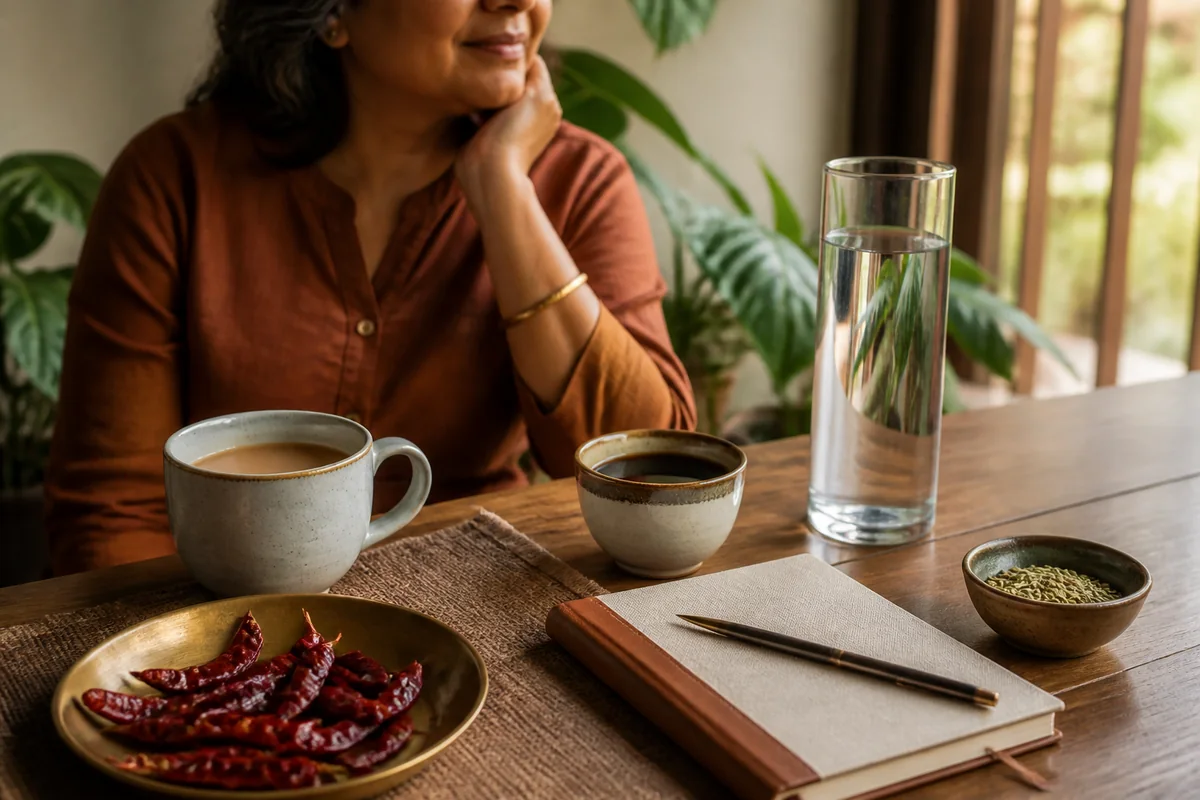
Hot-flush triggers are personal. Alcohol, late caffeine, very hot drinks or spicy food may worsen symptoms for some women and make no difference for others. Removing many foods at once makes the pattern harder to understand and can reduce nutrition unnecessarily. A two-week record that changes one factor at a time provides better information. Regular meals, enough fluid and fibre increased gradually often support steadier energy and digestion.
A practical plan for caffeine, spice and hot flushes
Review progress by function, not perfection. Ask whether you are sleeping a little better, thinking more clearly, moving with more confidence, experiencing less distress or returning to something that matters. Symptoms do not always disappear completely, and improvement may be uneven. A useful plan reduces burden and supports choice. If the issue is worsening, changing character or limiting daily life, that is information to bring back to a qualified professional.
Apply that approach specifically to caffeine, spice and hot flushes. Decide on one outcome that matters to you, such as fewer interruptions, less discomfort, better confidence or a clearer medical conversation. Choose an action that is safe within your health history and current capacity. Keep the rest of your routine reasonably steady while you test it. After one or two weeks, look at the pattern rather than one unusually good or bad day.
Context matters in India. Heat, long commutes, multigenerational homes, caregiving, food traditions, privacy and uneven access to menopause-informed care can all change what is workable. Adapt the advice rather than abandoning it. A cotton layer, a short indoor movement session, a familiar protein-rich meal, a teleconsultation or a private phrase to ask family for space may be more sustainable than an imported routine built for a different life.
What to discuss with a health professional
Seek a clinical conversation when caffeine, spice and hot flushes is new, severe, persistent, worsening or affecting sleep, work, relationships or safety. Take your symptom record and a complete list of medicines and supplements. Ask what common menopause-related mechanisms might fit, what other causes should be considered, whether tests are needed and which treatment options have evidence for someone with your personal risks and preferences.
Treatment decisions should be individual. Hormonal and non-hormonal options have different benefits, limitations and contraindications. Products marketed as natural can still have side effects and interactions. A qualified clinician can help weigh age, cycle stage, uterus status, breast and cardiovascular history, migraine, liver health, clotting risk and current medicines. Do not stop prescribed treatment or begin hormones based only on a general article.
Urgent symptoms should not wait for a routine menopause appointment. Seek prompt care for chest pain, fainting, sudden weakness or speech change, severe shortness of breath, a new severe headache, very heavy bleeding, bleeding after twelve months without a period, or thoughts of self-harm. Menopause can coexist with other conditions, and early assessment matters.
The Stri.life perspective
The purpose of learning about caffeine, spice and hot flushes is not to monitor yourself anxiously. It is to make the experience less mysterious and give you better choices. You deserve information that acknowledges both biology and the reality of an Indian woman’s day. Read what is useful, leave what does not fit and return to the question as your body and circumstances change.
Menopause is not a disease, but symptoms can be significant and deserve care. You do not need to wait until life becomes unmanageable, and you do not need to justify wanting relief. Evidence, personal values and a respectful clinical relationship can sit together. A safe community can add recognition, while medical decisions remain between you and a qualified professional.
Come back to this guide on caffeine, spice and hot flushes after you have observed your own pattern. The second reading is often more useful because you can separate what sounds familiar from what does not. Write down one question, one safe action and one sign that would prompt you to seek more help. Share the question with a clinician or someone you trust. Information becomes care only when it helps you make a clearer decision, ask for support or recognise that a change deserves attention. Stri.life will continue to review this article as menopause guidance develops, but your current symptoms and medical history should always guide the next step.
Frequently asked questions
Is caffeine, spice and hot flushes common during perimenopause?
It can occur during the menopause transition, but frequency and severity vary. A new, severe or persistent change should be assessed rather than automatically attributed to hormones.
How should I track caffeine, spice and hot flushes?
Record timing, duration, severity, cycle pattern, sleep and effect on daily life for one or two weeks. Include medicines or possible triggers only when relevant.
Do I need a hormone test?
Often, menstrual pattern, age, symptoms and medical history are more informative than a single fluctuating hormone result. Testing is useful in selected situations decided by a clinician.
When should I speak to a doctor?
Arrange care when symptoms are persistent, worsening or limiting daily life. Seek urgent help for red-flag symptoms such as chest pain, fainting, sudden neurological change, very heavy bleeding or self-harm thoughts.
Sources behind this guide
- ICMR-NIN: Dietary Guidelines for Indians ↗
- World Health Organization: Healthy diet, 2026 ↗
- National Institute on Aging: What is menopause? ↗
- World Health Organization: Healthy diet ↗
- Indian Menopause Society clinical guidelines ↗
- SWAN: Bone health over the menopause transition ↗
Editorial foundation: Stri.life research guides, Menopause in India Overview and Comprehensive Guide to Perimenopause, reviewed August 2026.
Conversation 0