 Movement
Balance training in menopause: build steadier movement, strength and confidence
Balance is a skill worth practising before it becomes a problem. Learn how it complements strength training, when to seek assessment and how to start safely.
Tap a card to reveal the answer. Start here, then read deeper whenever you are ready.
Balance is not only an older person's concern
Balance helps you step off a kerb, turn while carrying a bag and move confidently through a busy home. It depends on vision, inner-ear information, sensation, muscles and the nervous system working together. Age, medicines and health conditions can affect it [1]. Menopause does not mean you will become unsteady, and new imbalance should not automatically be blamed on hormones. Practising movement skills and evaluating symptoms are different tasks.
For a healthy woman in her forties or fifties, balance practice can be framed as skill building rather than an ageing label. Think about the movements you want to feel easier: stairs, uneven paths, getting dressed or travelling. This gives training a useful purpose beyond appearance. You do not need to wait until you have fallen, and you do not need a dramatic fitness challenge to take movement seriously.
What the evidence supports and where it is less direct
Strength and balance exercise are important parts of fall prevention in older adults. Aerobic, muscle-strengthening and balance activities provide different benefits [2,3]. Much of the falls evidence comes from older populations, so it should not be presented as proof that every menopausal woman needs the same fall-prevention programme. The reasonable midlife goal is maintaining strength and movement confidence, with a programme adapted to actual risks and ability.
An exercise that looks impressive on video is not automatically the most useful. Standing on an unstable surface while holding weights may add unnecessary difficulty for a beginner. Ask what skill the movement is training and whether you can practise it safely. A simple supported exercise that you repeat with control can be a better starting point than a performance designed to attract views.
Set up a safe practice space
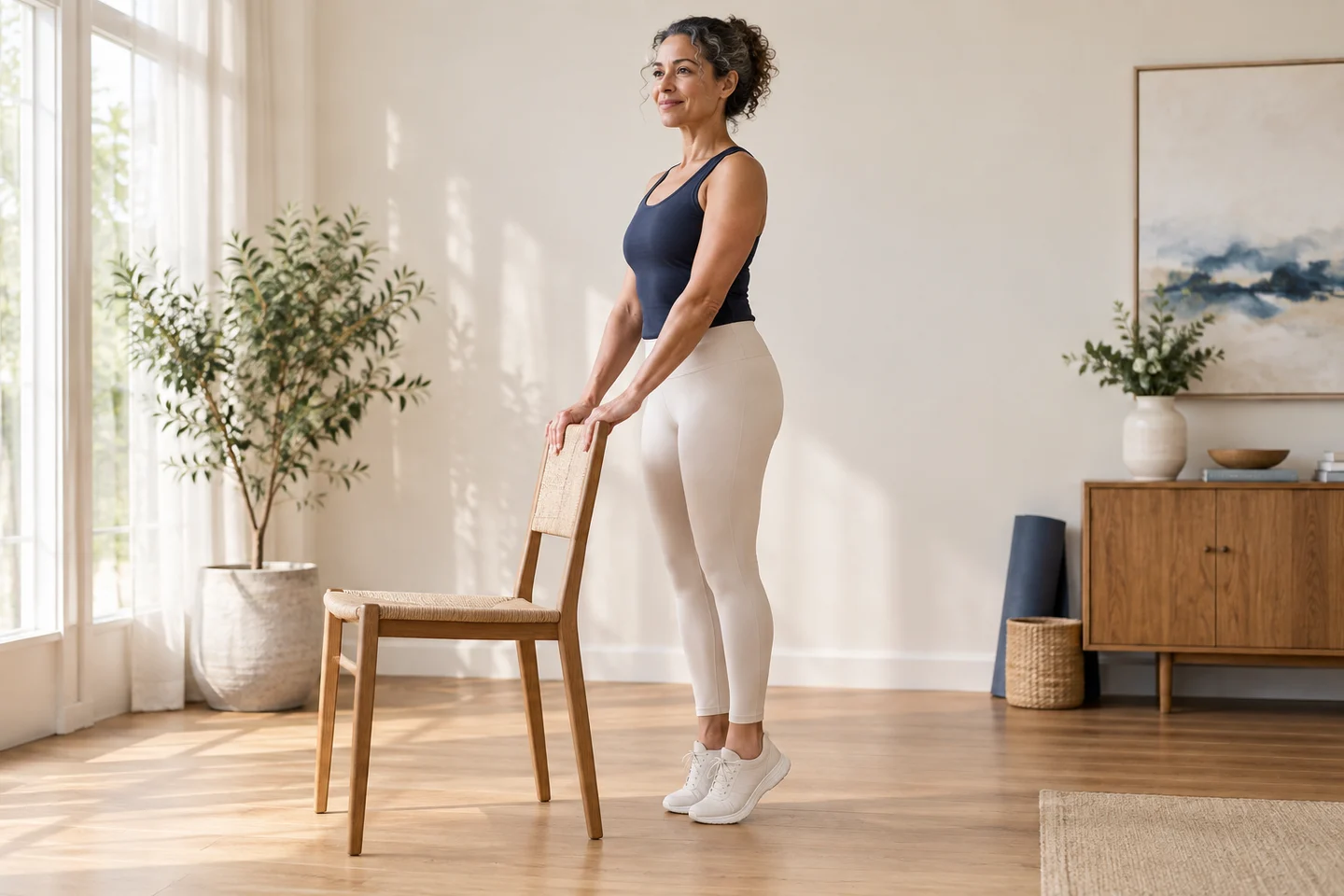
Use a stable chair or kitchen counter that will not slide. Clear loose rugs and clutter, choose secure footwear and practise with good lighting. Avoid slippery flooring and unsupported challenges if you are unsure of your balance [2]. If you have fallen, have significant dizziness, feel faint or have a neurological or heart condition, arrange assessment before attempting a new balance routine.
In an Indian home, choose the space deliberately rather than squeeze practice between wet bathroom tiles and a busy doorway. Keep the phone within reach without using it as a distraction. If having someone nearby makes you feel safer, arrange that first. The setting is part of the exercise; you should not have to take an avoidable fall risk in order to practise balance.
A gentle supported sequence to discuss with a professional
Examples of beginner tasks include standing with feet comfortably apart and shifting weight gently from side to side, rising slowly onto the toes while holding support, and placing one foot slightly in front of the other with a hand on the counter. Keep breathing, move slowly and stop if you feel dizzy or painful. These are illustrative starting ideas, not a personalised prescription or a test of whether you are normal [3].
Choose a small amount that feels comfortable and repeat it consistently before increasing difficulty. You do not need to close your eyes, remove all support or compete for the longest hold. Ask a physiotherapist how to progress if the task is too easy or if you are unsure about technique. Progress should mean greater control in your daily life, not simply less support at any cost.
Balance needs strength beside it
Lower-body strength helps with standing, stepping and recovering from a loss of balance. Resistance exercise and weight-bearing activity also have roles in bone health [4]. Balance drills do not replace a complete movement programme. Depending on your health and experience, suitable strength tasks might include supported sit-to-stand, a controlled step or other movements selected with a professional. Avoid assuming yoga alone covers every training need.
Plan different activities on different days if that makes the routine simpler. You might keep walking as your familiar aerobic activity and ask for a short strength routine separately. Do not add everything at once. Write down the two sessions you can realistically protect in the week and what would help you attend them. Consistency is easier when the plan respects your actual responsibilities and recovery.
Osteoporosis changes how a programme is adapted
Low bone density, a previous low-trauma fracture or osteoporosis may require specific movement precautions. NIAMS advises discussing exercise with a clinician or physical therapist when bone loss or other limitations are present [4,5]. Do not copy high-impact jumping or loaded spinal movements without individual guidance. The aim is safe strength and fracture prevention, not avoiding all activity out of fear.
Bring the bone-density report and details of previous fractures to the session. Ask which movements are suitable, what to avoid and how to handle lifting, bending and carrying in daily life. Request demonstrations, not just a list of names. A useful programme links the clinic advice to your home and work tasks so that safety becomes practical rather than a vague instruction to be careful.
Measure confidence without making exercise a test of worth
Instead of repeatedly timing a single-leg stand, notice whether everyday tasks feel steadier: turning, stepping onto a familiar stair or moving around furniture. Record what feels easier and what still worries you, then bring that information to a physiotherapist if needed. Do not turn a difficult movement into proof that your body is failing. The task may be unfamiliar, too challenging or unsuitable for your current circumstances. A useful programme can be adjusted without abandoning the goal of becoming stronger and more confident.
If the routine is becoming easy, change only one feature after checking safety: the amount of repetition, the movement range or the level of support recommended by your professional. Keep other conditions stable so you can understand the effect. Stop and seek advice if new dizziness, pain, weakness or near-falls appear. It is not necessary to progress every session. Some weeks, maintaining the routine while sleep or work is difficult is a meaningful achievement. Long-term movement confidence comes from appropriate challenge and consistency, not proving how much risk you can tolerate.
When imbalance is a medical symptom, not a fitness problem
Sudden imbalance with facial droop, weakness, difficulty speaking, severe new headache or a major change in vision needs urgent medical care. Fainting, chest pain and repeated unexplained falls also deserve assessment. Persistent unsteadiness may involve medicines, blood pressure, vision, nerve problems or the inner ear [1,2]. Practising harder is not the right response to an unexplained new symptom.
For a well woman beginning practice, a reasonable next step is a safe space, a supported task and a simple plan for repetition. For a woman with symptoms, the next step is assessment. Keep that distinction clear. This article is general education and does not replace a physiotherapy or medical evaluation. Your exercise choices should reflect your health, bone risk, preferences and confidence, not a generic menopause label.
Frequently asked questions
Must every menopausal woman follow a falls programme?
No. Training should match personal risk and ability; much falls research concerns older adults.
Can I practise with a chair?
Yes. Stable support and a clear, well-lit space are sensible starting conditions.
Should I close my eyes to make it harder?
Not as a default beginner step. Progression should be safe and adapted, preferably with professional guidance if uncertain.
Is balance practice enough for bone health?
No. Strength, appropriate weight-bearing activity, nutrition and bone-risk assessment have different roles.
When should I seek urgent help?
Sudden imbalance with weakness, facial droop, speech difficulty or severe new headache needs urgent assessment.
Sources behind this guide
- [1] NIA: Older adults and balance problems ↗
- [2] NIA: Falls and fractures prevention ↗
- [3] NIA: Three types of exercise ↗
- [4] NIAMS: Exercise for bone health ↗
- [5] NIAMS: Osteoporosis diagnosis and steps to take ↗
Editorial foundation: Stri.life research guides, Menopause in India Overview and Comprehensive Guide to Perimenopause, reviewed August 2026.
Conversation 0